
When the Wrong Piano Met the Right Musician
How Keith Jarrett Created a Magical Concert

I really love those “Year in Review” features that music apps like Apple Music and Spotify create.

I find it fun to see which artists dominated, how my listening patterns shift, and how different genres of music flow together.
My monthly top artists in 2025 included people like Taylor Swift, Haim, Lady Gaga…and Keith Jarrett.

If you’re not familiar with Keith Jarrett, you might find it odd that he sits in rotation alongside pop icons.
I discovered him a few years ago when I read that, in 1975, he performed a concert on a piano that was never meant for the stage — and that the recording of that night went on to sell millions of copies.
Instantly, I was curious…
On January 24, 1975, pianist Keith Jarrett had a problem.

He was scheduled to perform a sold-out concert at the Cologne Opera House in Germany that night.
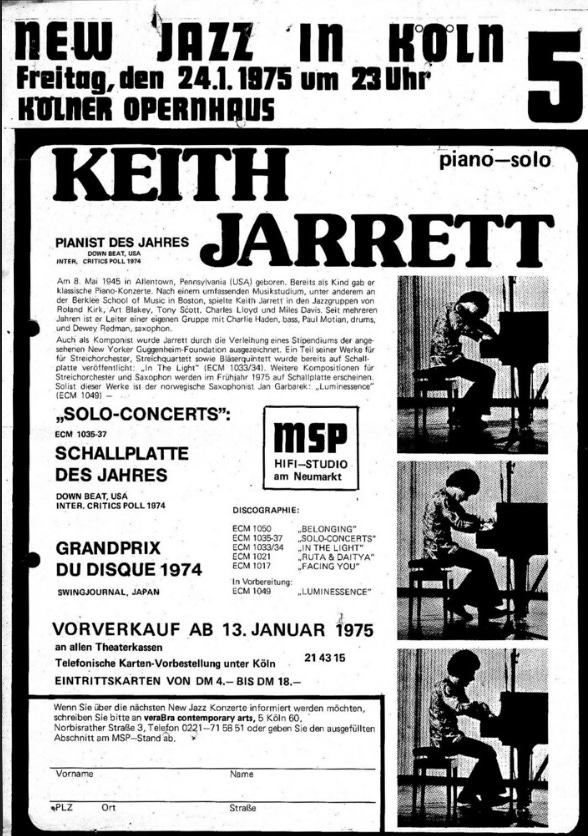
But when he arrived for rehearsal, he discovered that the 10 ft-long Bösendorfer 290 Imperial concert grand piano he requested wasn’t there.
Instead, a 6-ft Bösendorfer baby grand, intended for opera rehearsals, was sitting on the stage.
And it was in bad shape.
The piano was badly out of tune.
The keys were sticking.
The pedals didn’t work properly.
Jarrett was a known perfectionist.1
This was not the kind of instrument he wanted to play before a full house.
He was also exhausted from travel, and suffering from excruciating back pain.
“We had the wrong piano,” Jarrett later recalled in an interview.
“I had not slept for two days. Everything was wrong.”
With only hours before the performance, there was no time to source a replacement.
Jarrett was prepared to cancel.
But Vera Brandes, a 17-year-old German student and jazz enthusiast who had organized the concert, refused to give up.

She persuaded Jarrett to stay while technicians did what they could to improve the instrument.
They managed to tune it, but couldn’t do much to improve its tone and timbre, which was defined by jangly high notes and a less-than-resonant bass register.
And the piano’s sustain pedals still weren’t working when Jarrett walked on stage that evening.
Jarrett, an exhausted musician who possessed perfect pitch, was about to perform in front of a packed hall on a sub-par instrument.
It looked like a recipe for disaster.
But instead, the concert became musical legend.
The piano in front of Jarrett was unlike the ones he normally played.
So he played it differently.
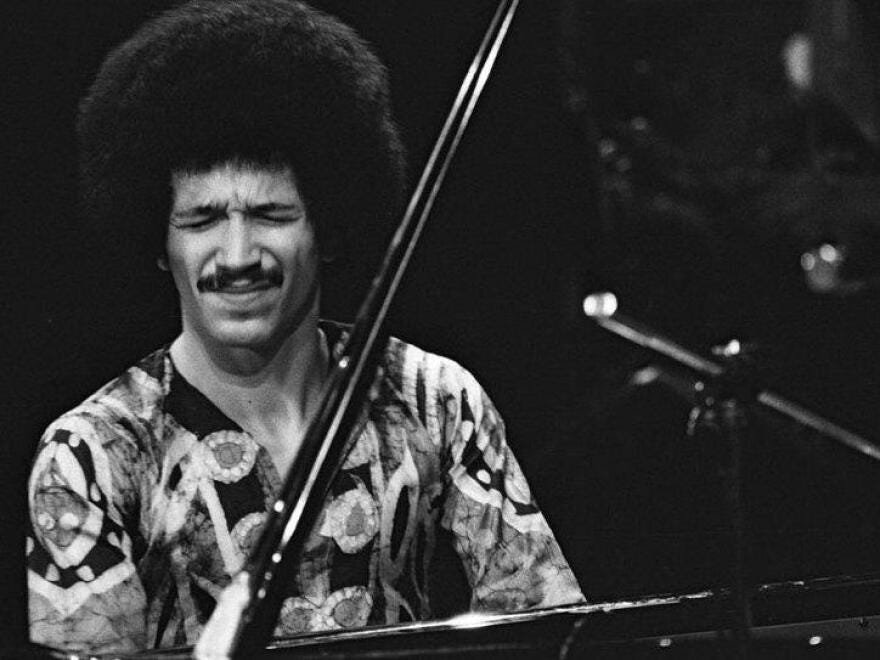
He got creative – and leaned into what the instrument could do rather than fighting what it couldn’t.
“You always want to make it as good as it can be, but when you have problems that you can’t do anything about, one after another, you start forgetting actually what you’re doing, and that’s one of the secrets,” Jarrett later said.
For one-hour, Jarrett performed a completely improvised set, blending jazz with elements of folk, classical, Latin, gospel hymnals – and even country music.
The result was a performance that listeners still describe as intimate, hypnotic, emotional and transcendent.
And the magic Jarrett created that night in Germany was recorded. The album, The Köln Concert, went on to sell more than 4 million copies, becoming the best-selling solo piano album in history.2

Not despite the “broken” piano — but in part, because of it.
If you’re curious, I highly recommend listening to The Köln Concert:
Just press play and imagine a young promoter backstage, a tired musician on a compromised instrument, and a room about to witness history.
One more thing…
Jarrett may have made magic on the stage that night, but the concert would not have happened without Vera Brandes.

Interviewed by the Guardian in 2025, Brandes, a music producer and researcher, was asked why Jarrett eventually agreed to play the show in 1975.
She responded:
“I think there are several reasons. First of all, Manfred Eicher had already paid Martin Wieland to record it, with two microphones, to take advantage of the unique acoustic of the opera house, so maybe there was pressure.
“But I think it was mainly personal pride. If Keith had cancelled he would have been in despair, sitting in his hotel, with 1,400 angry punters outside the theatre. He’s not the kind of performer who cares about his audience – he’s driven only by a love of his own art.
“But I think he would have been angry at himself if he’d failed to take on the challenge.”
A loosely fictionalized film, Köln 75, details the chaotic behind-the-scenes scramble to get Keith Jarrett on stage that night, and captures Vera’s resourcefulness and determination to make it happen.

How Can I Help?
I’ll keep saying it: Communication matters.
If you want to improve your communication (and get all the good things that come with that), I’m your gal.
So many companies could reap significant benefits – from performance and culture to retention and engagement – by improving their communication.
So, if you know someone who could benefit from some help (as even the most seasoned leaders do), please get in touch and check out my website for more information.
You can also see my Top 10 list of what I can (and can’t) do for you here.
And if you see any communication examples (the good, the bad, and the ugly) that you think are worth analyzing or sharing, please send them my way!
Stay Curious!
-Beth

Jarrett insisted the crowd be quiet at his shows, and even stopped shows when there was audience noise. I read the audience even received cough drops at some of his concerts so as not to disturb his flow with their coughing. Dude was not messing around.
In a 2020 interview with The New York Times, Jarrett revealed that he suffered two strokes in 2018, leaving his left side partially paralyzed, and making it unlikely he will ever perform onstage again.
This is such a fantastic piece on the Koln Concert. The bit about Jarret forgetting what he was doing when everything went wrong is lowkey one of the most underrated insights into creative flow. I've had similar moments where constraints forced me to improvise in ways i never would have otherwise and those ended up being my best work. The fact that Vera Brandes was only 17 and still managed to pull off convincing him is wild.
<3 <3 <3